
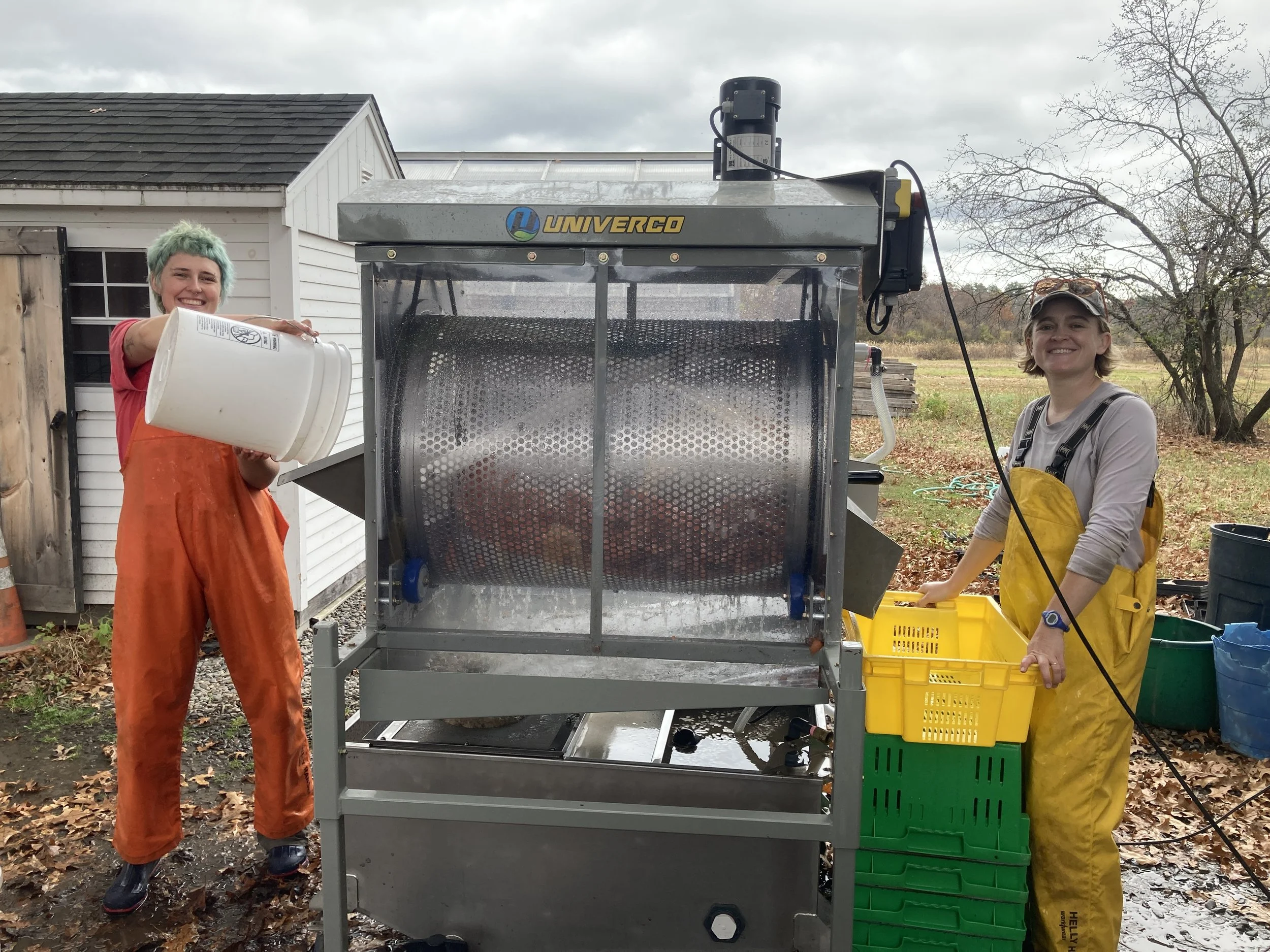
We took advantage of the warm weather last week and harvested a bulk batch of topped (no greens) carrots. In prior years, washing those carrots was the limiting factor in how much we could harvest in a day. Whoever washed carrots would have to spray everything off by hand, which was very time consuming. The carrot washer would have to be turning carrots over constantly to get them cleans, which made for some wet and numb hands on cold days.
Since we got our new barrel washer this spring (funded by a grant from the MA Department of Agricultural Resources), though, the sky is the limit! Carrots are dropped into the metal barrel, which turns while water is sprayed on them. The person who is doing the wash for the day is then freed up to wash other veggies while the barrel washer does its thing. We’re able to get through so many more carrots now, and they look cleaner than we could ever get them unless we went over everything with a scrub brush!
While we had a strong enough carrot harvest to warrant using the root washer this week and last week, due to a lot of feasting by mice and voles in the field, there were not as many usable carrots as we would have hoped. We’ll work on a plan for that this winter so that next year we can be putting that root washer even more!
In the CSA this week:
Popcorn! On the cob. Remove the kernels and it is ready to pop on the stove, in an air popper or in the microwave in a paper bag. Tips for perfect stove top popcorn available here!
Sweet potatoes
Butternut squash
Tetsukabuto squash - Described in seed catalogs as “the squash of the apocalypse,” as the plants are resilient and the squash themselves store quite well. They have a smooth texture and a slightly nutty flavor.
Autumn Frost squash - This is a specialty type of butternut that is just as sweet, stores really well and has the side benefit of being extra pretty (so if you have a high degree of self-control and wanted it to decorate your table for a couple of weeks before you eat it, go right ahead!). It also has a thin skin that is edible like delicata.
Leeks
Yellow onions - These are cured (unlike the fresh onions we had in the summer) and should be stored in a cool and dry place.
Garlic
Carrots
Mini daikon - White, purple and red varieties
Turnips
Cabbage - Purple and green varieties.
Salanova
CSA Pick-Your-Own:
Herbs: Parsley
In the Mini Storetore:
The Mini store is open during our CSA pick-up Wednesday 11am-6pm and Saturday 9am-3pm. Please note 2026 Barrett’s Bucks have expired, but we do still take cash, credit card and EBT. This week we’ll have:
Salanova
Leeks
Onions
Winter squash: Butternut, Autumn Frost and Tetsukabuto
Wreaths - Barrett’s Mill Farm dried flowers on wreath bases made from grapevines foraged on the property. You’ll find week’s wreath selection on the back wall of the farm stand. Wreaths can be hung in any direction. Hang out of direct sunlight to prevent colors from fading.
Salsa verde - The 2026 batch is here! Made by Kenneth at Eastern Mass Provision from our own organic tomatillos, onions, garlic and cilantro. We should have the 2026 hot sauce soon as well!
Fresh Organic Cranberries - From Fresh Meadows Farm in Carver, MA. Certified Organic.
Heirloom Apples - This week we have two storage varieties with really lovely sweet flavors great for fresh eating or cooking: Blue Pearmain and Black Oxford (limited availability). As they are both storage apples, the skins are slightly thicker, so some people may prefer them peeled. The skins do break down when sauced, and the Black Oxford variety will actually make a pink applesauce if you leave the skins on! From Scott Farm in Dummerston, VT. Eco-certified.
Pink Lady Apples - From Autumn Hills Orchard in Groton, MA. Not Organic.
Baer’s Best Beans - Black Turtle, Italian Cranberry, and Cannellini are Certified Organic. Bumblebee and Black Coco are not organic. Grown by Charley Baer in South Berwick, ME.
Raspberry Vinegar Infusion and Raspberry Jam from Silferleaf Farm in Concord, MA. Certified Organic.
Roasted Carrots With Whipped Tahini
By Alexa Weibel, from NY Times Cooking
Ingredients
1 ½ pounds medium carrots
2 tablespoons olive oil, plus more for serving
½ teaspoon curry powder or berbere seasoning
Salt and black pepper
1 orange or lemon
2 tablespoons shelled pistachios (preferably roasted and salted), chopped
2 tablespoons chopped dill
1 tablespoon minced chives (optional)
⅓ cup plain Greek yogurt
3 tablespoons tahini
1 small garlic clove, finely grated
Preparation
Heat the oven to 425 degrees. Peel the carrots, then cut them into pieces: Positioning your knife at a sharp angle, cut off a 2-inch piece of carrot, then rotate the carrot and continue cutting into 2-inch pieces, forming imperfect shapes. (Too fussy? Just cut the carrots at a sharp angle into 2-inch spears.)
On a large, foil-lined rimmed sheet pan, toss the carrots with 2 tablespoons olive oil and the curry powder; season generously with salt and pepper. Roast until browned in spots and softened, 20 to 25 minutes. (Feel free to make ahead, as the carrots taste just as good at room temperature as they do hot out of the oven.)
While the carrots cook, prepare the topping: Finely grate 1 teaspoon orange zest onto a cutting board. (Set the orange aside.) Add the pistachios, dill and chives (if using), and chop together until minced and combined.
Make the tahini cream: Cut the orange in half. Squeeze 3 tablespoons of juice into a mini food processor or blender. Add the yogurt, tahini, garlic and 2 tablespoons water, then blend. (Alternatively, you can vigorously whisk them together in a bowl, although the results won’t be quite as fluffy.) Season to taste with salt and pepper. (Makes ⅔ cup.) Spread the mixture onto your serving platter.
Give the roasted carrots a squeeze of orange juice and drizzle with olive oil; toss to coat directly on the sheet pan and season with additional salt, pepper and juice as needed.
Arrange the carrots on top of the tahini cream, drizzling any dressing from the sheet pan on top. Sprinkle with the pistachio topping, sprinkle with salt, if needed, and serve.
Roast Squash With Crispy Chickpeas and Feta
Adapted from a recipe by Dan Pelosi, from NY Times Cooking
The original recipe called for delicata, acorn and kabocha, but it works just as well with the tetsukabuto and Autumn Frost we have in abundance right now! Both have edible skins (and certainly much thinner skins than acorn!)
Ingredients
3 medium shallots, halved and sliced
½ cup apple cider vinegar
1 (15-ounce) can chickpeas, rinsed
6 tablespoons extra-virgin olive oil
Kosher salt
1 medium Autumn Frost squash, halved lengthwise, seeded and sliced into 6 wedges
1 medium Tetsukabuto squash, halved lengthwise, seeded and sliced into 8 wedges
Ground cayenne
2 teaspoons smoked paprika
8 ounces feta, crumbled into large pieces
¼ cup loosely packed fresh mint leaves
Honey, for serving
Preparation
Place two oven racks in the top third and center of the oven and heat the oven to 400 degrees.
In a small bowl, toss the shallots with the apple cider vinegar. Set aside to marinate.
Pat the chickpeas completely dry with paper towels, then spread them out on a large rimmed sheet pan. Drizzle with 2 tablespoons of the olive oil, sprinkle with salt and toss to coat. Spread out in a single layer.
On a second large rimmed sheet pan, add all three types of squash. Drizzle with the remaining 4 tablespoons olive oil and sprinkle with a good pinch of salt and a light dusting of cayenne. Toss to coat, then arrange in a single layer. (Some squash can go on the sheet pan with the chickpeas, if needed for space.)
Place the chickpeas on the top rack and the squash on the center rack of the oven and roast for about 30 minutes, until the chickpeas are beginning to crisp and the squash is very tender. Remove the chickpeas from the oven. (If you roasted some of the squash with the chickpeas, transfer it to the pan with the rest of the squash.) Sprinkle the paprika over the top of the chickpeas and shake the sheet pan to coat. Set aside to cool and finish crisping on the sheet pan. The chickpeas can be cooled and stored at room temperature in an airtight container for up to 24 hours.
Turn on the broiler and move the squash to the top oven rack. Cook for 3 to 5 minutes, until nicely charred. Use tongs to pile the squash onto a serving platter.
Scatter the chickpeas over and around the squash. Drain the shallots and sprinkle them over the squash, along with the feta and mint. Drizzle a generous amount of honey over everything and finish with a couple more pinches of cayenne before serving. This recipe can be served warm or at room temperature.
Carrot-Orange Olive Oil Cake
By Kiano Moju, from NY Times Cooking
Ingredients
Yield:One 9-inch cake (8 servings)
Nonstick cooking spray or butter, for greasing
1 ⅓ cups/175 grams all-purpose flour
1 tablespoon baking powder
1 teaspoon ground cardamom
1 teaspoon kosher salt (such as Diamond Crystal)
¼ teaspoon baking soda
5 medium carrots (about 10 ounces/300 grams), peeled and roughly chopped (about 2 cups)
1 cup/210 grams extra-virgin olive oil
1 cup/200 grams granulated sugar
2 large eggs, at room temperature
1 orange, zested and juiced (¼ cup juice)
Powdered sugar, to serve
Preparation
Arrange a rack in the center of the oven. Heat the oven to 375 degrees. Grease a 9-inch springform pan, cake pan or cast-iron skillet with nonstick spray or butter, and line the bottom and sides with parchment paper.
In a large bowl, whisk the flour, baking powder, cardamom, salt and baking soda together. Make a well in the middle and set aside.
In a blender, combine the carrots, olive oil, granulated sugar, eggs, orange zest and orange juice; blend until smooth. Pour into the middle of the well of the dry ingredients. Starting in the center, use a whisk to slowly incorporate the flour mixture until there is no visible flour.
Pour the batter into the prepared pan. Lower the oven temperature to 350 degrees and immediately place the cake onto the middle rack. Bake for 35 to 45 minutes, until the center comes out clean when tested with a toothpick.
Let the cake cool on a wire rack for about 1 hour, then remove from the pan. Before serving, dust with powdered sugar.